

Complete JRPG Walkthrough Guide: Finish Every Quest in One Playthrough

Yuto Gameguide
JRPG & Visual Novel Guide Writer · July 16, 2026
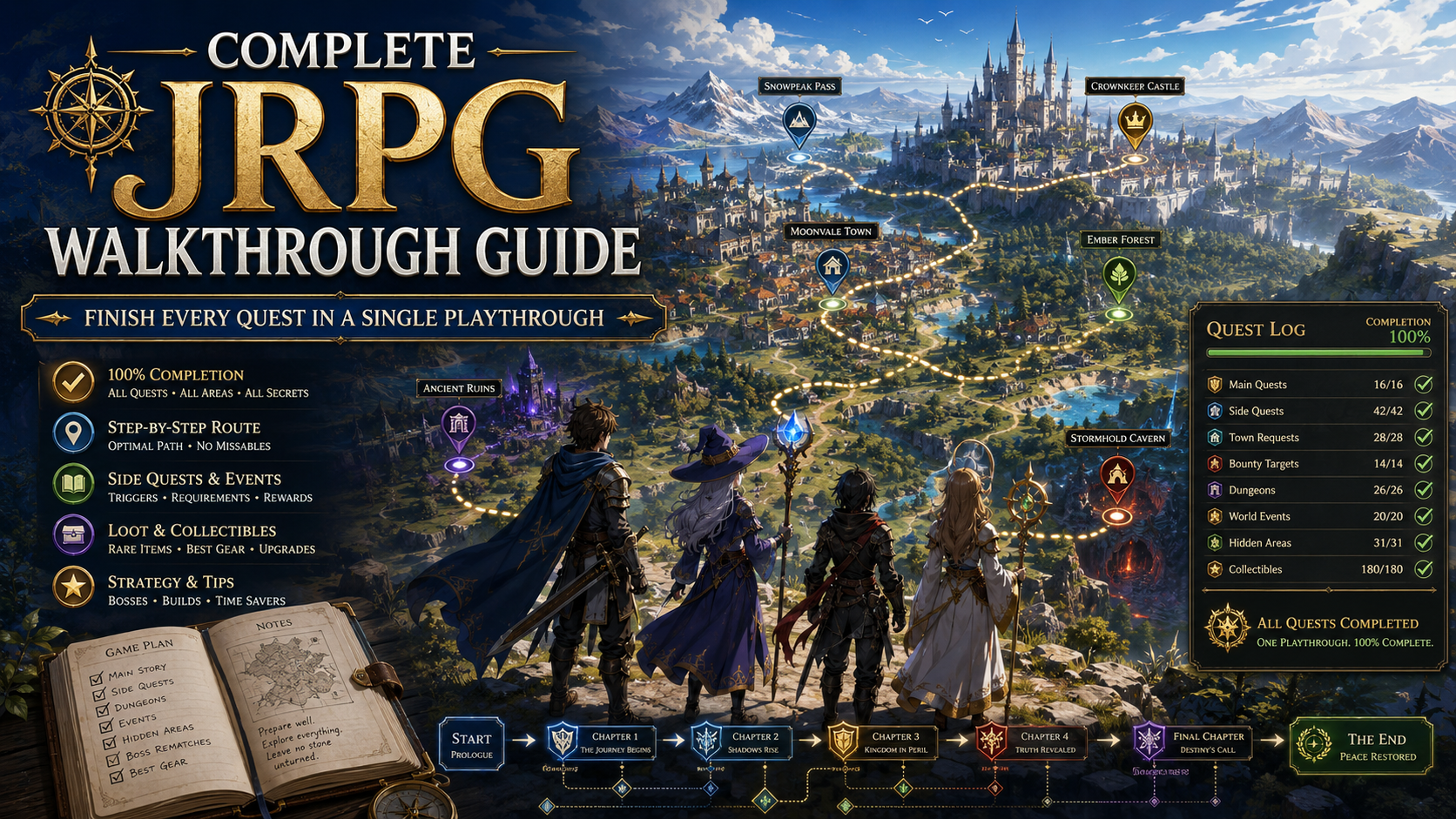
Completing 100% of the quests in a top-tier JRPG in 2026 is not a matter of luck. It requires attention to detail and careful planning throughout the entire playthrough. This guide explores professional techniques for managing both main quests and side quests so you can complete everything in a single run, save time, and enjoy the most complete experience possible.
For players who want to master this genre, expert planning is not merely an option. It is the main path that prevents you from missing even the smallest piece of important content.
Why Expert Quest Planning Is Better Than Simply Playing as You Go
Experienced players know that many JRPGs contain a Point of No Return. Once you pass this point, you may permanently lose access to important side quests until you begin another playthrough through New Game Plus.
Some games require more than 80–100 hours to complete. Having to restart the entire adventure because you forgot to speak with a single NPC is one of the worst situations a completionist can face.
From my own experience, I once missed an important quest in a major game released earlier in the year. That mistake made me realize how essential it is to create a personal JRPG walkthrough.
Speaking with every NPC after an important Story Trigger is one of the most valuable habits you can develop. These characters often unlock hidden side quests after major events. Missing a single conversation could cause you to lose access to a special reward, legendary item, or optional storyline permanently.
Side quests in modern JRPGs also tend to reveal secrets about the game world that are never explained in the main story. Completing every quest is therefore not only about reaching 100% completion. It is also an important part of fully understanding the world of the game.
Always watch for major story cut-off points: Check the progression of the main story and identify moments when the world may change, a location may become inaccessible, or an area could be destroyed.
Complete side quests in the right order: Finish quests located in the same area before advancing the main story. This reduces loading time and prevents unnecessary backtracking.
Prepare resources in advance: Some quests require rare items that must be farmed. Collecting them early will make future objectives much easier and prevent you from repeatedly travelling between the same locations.
Time Management and Quest Planning on Large Maps
As more modern JRPGs adopt open-world or large-zone structures, completing quests without a clear plan can cause you to spend more time travelling than progressing through the story.
You need to learn how to identify connections between objectives on the map and plan your route like a strategic board-game player.
A strong JRPG walkthrough begins by reviewing your active quest list and grouping objectives according to their locations. This technique is known as Proximity Grouping.
For example, suppose you need to deliver an item in the same zone where you are hunting monsters to gain experience. Instead of making separate journeys, complete both objectives during the same trip.
This is one of the most effective techniques used by experienced players who want to manage their time efficiently.
Knowledge gained from Story Analysis can also help you predict which quests are connected to urgent story events and which ones can safely be delayed. Understanding the difference reduces pressure and gives you more time to focus on creating the perfect character builds.
Remember that in some games, story choices can affect character relationships. This is also connected to JRPG Tier content, which can help you identify the best characters to bring on specific quests to maximise relationship points.
Choosing a character who is closely connected to a particular quest may also unlock secret dialogue that other party combinations cannot access. Researching character requirements in advance is therefore an important technique for achieving 100% completion in a single playthrough.
Build Strategies for Completing the Most Difficult Quests
Some optional quests in 2026 JRPGs are designed to be even more difficult than the main story bosses. To overcome these challenges, you need flexible builds that can adapt to different situations.
Experienced players usually prepare at least two types of builds.
The first focuses on Burst Damage, allowing the party to defeat groups of enemies quickly during combat-heavy quests.
The second focuses on Sustainability, providing stronger defence, healing, and resource management for hidden dungeons where save points may be unavailable.
Players who are unsure which direction to take with their builds can explore SimGuide, which covers detailed strategies for managing equipment, items, and character skills.
Having a personal reference guide allows you to make faster decisions in every situation, whether you need to switch weapons before a battle or select support abilities that match a quest’s special requirements.
Remember that damage is not the only answer in a good JRPG walkthrough.
Crowd Control abilities, status effects, and elemental counters can be more valuable than simply producing the highest damage numbers. When you know a boss’s weaknesses or quest conditions in advance through information from Story Analysis, you can create a party that perfectly counters the challenge.
Successfully executing that strategy is one of the most satisfying experiences the genre has to offer.
The Path to Becoming a Complete JRPG Player
Completing every quest in a single playthrough is not merely about clearing every objective from a checklist.
It allows you to experience every detail of the world that the developers carefully created. Seeing the conclusion of a side quest connect back to the main storyline during the final chapters is one of the most rewarding moments a dedicated JRPG player can experience.