

Online Dummy Explained: Easy Guide to Knocks and Scoring

Yuto Gameguide
JRPG & Visual Novel Guide Writer · October 9, 2026
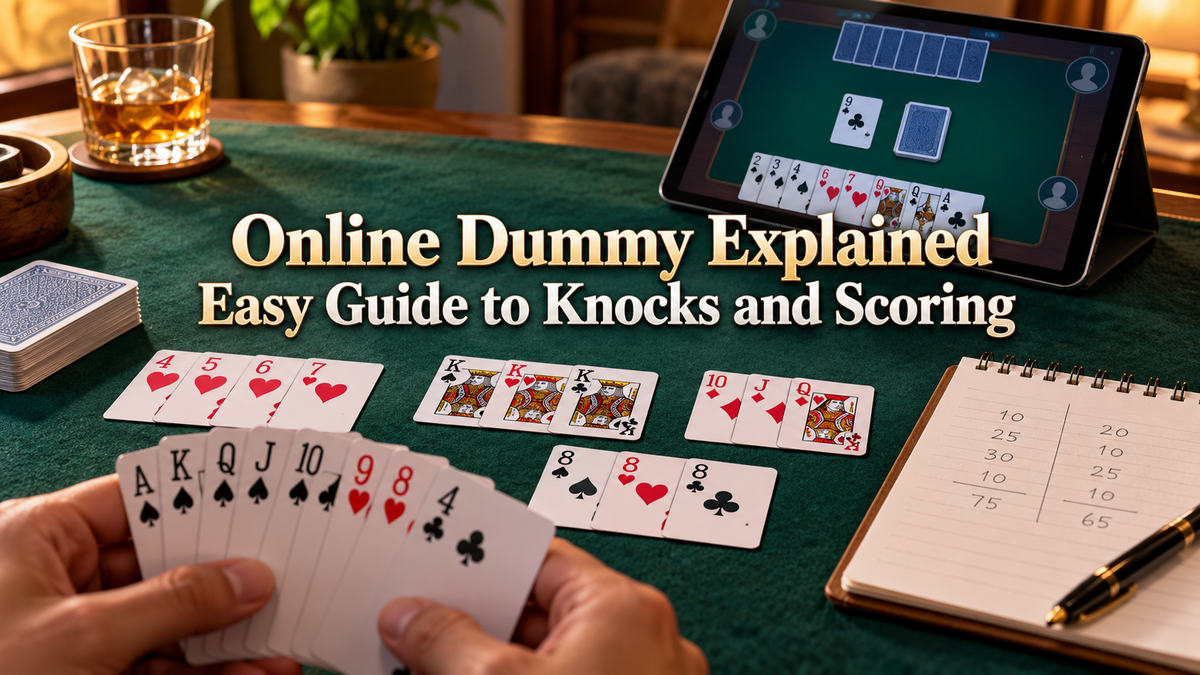
Online dummy is a card game played with one 52-card deck at tables of two to four players. Each player is dealt seven cards and works to arrange them into melds before knocking to end the round and tallying the score. This easy guide explains adding cards, knocking, and end-of-game scoring so you can start with confidence.
Key Takeaways on Online Dummy
- Melds are either same-rank sets or same-suit runs in sequence.
- Adding cards means attaching a card to a meld already on the table.
- A knock ends the round when your hand is empty or nearly empty.
- The final score is the table total minus the cards left in hand.
How an Online Dummy Round Begins
Online dummy uses 52 cards. Every player receives seven cards, and one card is turned face up as the head card. Players take turns drawing from the stock or picking up from the discard pile, then discard one card to end the turn. The aim is to arrange your hand into as many melds as possible.
There are two kinds of melds. The first is three or four cards of the same rank. The second is three or more cards of the same suit in consecutive order. Once a meld is complete, it can be laid down on the table.
How Adding Cards Works in Online Dummy
Adding a card means attaching a card from your hand to a meld already on the table, whether it belongs to you or to another player. For example, if a same-suit run of 4, 5, 6 is on the table and you hold the 7 of that suit, you can add it to the end at once.
Adding cards reduces what is left in your hand and increases your table points, which is a key skill separating new players from experienced ones. Keep checking the table for melds that still have room to extend.
Knocking in Online Dummy: Types and Timing
A knock ends the round when your hand is empty or only one discardable card remains. There are several types: a regular knock, a light knock that reveals the whole hand, and a color knock where all seven cards form one run in a single suit, which earns a larger bonus.
Timing a knock depends on how many cards your opponents probably still hold. Knock too late and they may add cards and take the lead; knock too early and you may miss a chance to score more.
Counting the Score at the End of Online Dummy
Cards carry different point values. Cards from 2 to 9 are worth 5 points each, 10, Jack, Queen, and King are worth 10, the Ace is worth 15, and the two special cards, the 2 of clubs and the Queen of spades, known as the Speto cards, are worth 50 each.
At the end, cards laid on the table count as positive points, while cards left in hand count as negative. If a player shows both Speto cards, the bonus is doubled, so it pays to protect the special cards before closing the round.
Common Mistakes Beginners Make in Online Dummy
The first mistake is holding high-value cards for too long, especially the Ace at 15 points, because an unexpected knock from an opponent leaves you with a heavy negative score. The second is forgetting to add cards even when the table offers a spot, which leaves extra cards in hand for no reason.
Another is rushing to knock while a Speto card is still in hand. A single 50-point card can flip the final result, so lay it down in a valid meld before closing the round whenever possible.
Online Dummy Turn Order and Tips to Improve
One turn can be summarized as follows:
- Draw from the stock or pick up from the discard pile.
- Lay down a complete meld, or add a card to an existing one.
- Discard one card to finish the turn.
- Knock when your hand is empty and you are ahead on points.
To get better at online dummy, practice these habits one at a time:
- Remember discarded cards to estimate what opponents are holding.
- Keep as few high-value cards as possible near the end.
- Add cards at every opportunity to cut down what remains in hand.
Online Dummy Wrap-Up: Know the Rules, Enjoy More
The rules of online dummy are not complicated once you understand melds, adding cards, knocking, and end-of-game scoring. When you know when to close a round and how to protect the Speto cards, planning becomes clearer and the game becomes far more enjoyable.
This article offers educational information only and does not encourage anyone to play. If play starts to feel out of control, take a break and contact a support organization such as BeGambleAware.org.